What is AI Search Optimisation? A Plain-English Guide
AI search optimisation gets your business cited in ChatGPT, Gemini, Perplexity, and AI Overviews. What it is, why it matters, and how it works.
AI search optimisation helps AI platforms find and recommend your business. You structure your site so tools like ChatGPT, Gemini, Perplexity, and AI Overviews cite you in their answers. It includes GEO (Generative Engine Optimisation), AEO (Answer Engine Optimisation), and LLMO (Large Language Model Optimisation).
Quick Reference
Direct Answer
AI search optimisation gets your business cited in ChatGPT, Gemini, Perplexity, and Google AI Overviews. It includes GEO, AEO, and LLMO.
Summary
AI search optimisation structures your website, content, and brand presence so AI platforms cite you. 48% of queries show AI Overviews. AI visitors convert at 27% vs 2.1% standard. Covers ChatGPT, Gemini, Perplexity, AI Overviews, Claude, and Copilot.
This Page Covers
What AI search is, how it works, types (GEO/AEO/LLMO), what it involves, costs, getting started
Not Covered Here
Individual platform guides (see how-to pages), agency comparison (see /best-ai-search-agencies/), tool comparison (see /best-ai-search-tools/)
Why it matters
48% of Google queries now show AI Overviews. ChatGPT handles 2.5 billion prompts daily. 65% of those are search-like queries. When an AI Overview appears, organic clicks drop 61%. But sites cited in the AI answer get 35% more clicks. AI search is not replacing traditional search. It is reshaping where the clicks go.
AI search visitors convert at 27%, compared to 2.1% from organic. That is 13x higher. This makes sense. Someone asking ChatGPT "which AI search agency should I use for my law firm?" is closer to buying than someone Googling "AI SEO".
How AI search engines work
AI search engines do not rank pages. They build answers from multiple sources. ChatGPT draws from training data, live web browsing (via Bing), and retrieval-augmented generation (RAG). Your business only appears if AI systems are confident about who you are and what you do.
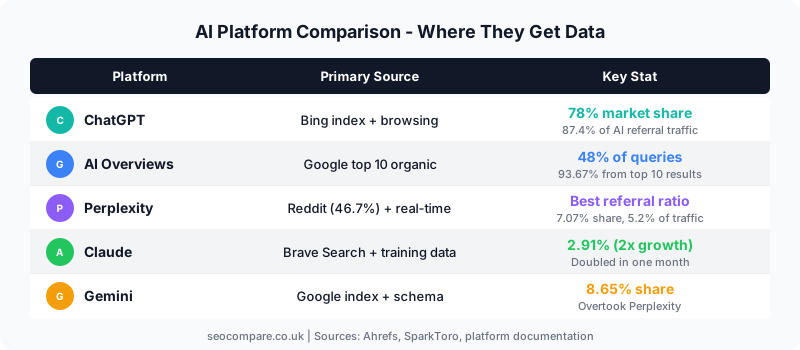
Each platform works differently:
| Platform | Primary source | What it prioritises |
|---|---|---|
| ChatGPT | Bing index | Brand mentions (0.664 correlation). 87.4% of AI referral traffic. |
| Google AI Overviews | Google search index | Must rank top 10 first. E-E-A-T. Multi-modal content. |
| Perplexity | Real-time sources, Reddit | Recency. Updates every 2-3 days matter. Promotional content ignored. |
| Claude | Training data | Depth. Bullet-pointed pages 30% more likely cited. |
| Gemini | Google index | Schema markup. Entity relationships. Freshness. |
The different types of AI search optimisation
Several acronyms exist in this space. They all sit under AI search optimisation:
GEO - Generative Engine Optimisation
GEO focuses on getting cited in AI-generated answers. You structure content so AI engines can extract clean, quotable answers. This means answer capsules (40-60 word blocks after headings), comparison tables, specific data, and clear language. GEO is the broadest and most common term, introduced in a 2023 research paper (Aggarwal et al.).
AEO - Answer Engine Optimisation
AEO targets zero-click answers. These include featured snippets, AI Overviews, and direct AI responses. AEO predates GEO. It started as voice search and answer box optimisation. Today it is largely the same as GEO.
LLMO - Large Language Model Optimisation
LLMO targets LLM-powered platforms like ChatGPT, Claude, and Gemini. It focuses on how language models process and retrieve information about your business. This differs from how search engines index your pages.
What AI search optimisation involves
AI search optimisation covers several areas:
1. Entity clarity
AI platforms need to know what your business is, what it does, and who it serves. Use the same description across your website, Google Business Profile, LinkedIn, directories, and schema markup. When multiple sources agree, AI confidence rises.
2. Content structure
Format your content so AI can pull clean answers. Use clear H2/H3 headings. Add 40-60 word answer capsules after each heading. Include comparison tables, numbered lists, and FAQ sections with schema markup.
3. Schema markup
Structured data tells AI engines what your content is. Organisation schema sets your brand identity, Person schema attributes authorship, and Speakable schema marks your most extractable sections. Google recommends adding structured data in JSON-LD format. Note that Google deprecated FAQ rich results for most sites in 2023, so FAQPage markup no longer provides a search-appearance benefit.
4. AI crawler access
Allow AI crawlers to access your site via robots.txt. The relevant agents are documented by the platforms themselves: OpenAI (GPTBot, OAI-SearchBot), Anthropic (ClaudeBot), and Perplexity (PerplexityBot). Blocking these in robots.txt removes your content from the corresponding AI answers.
5. Brand building
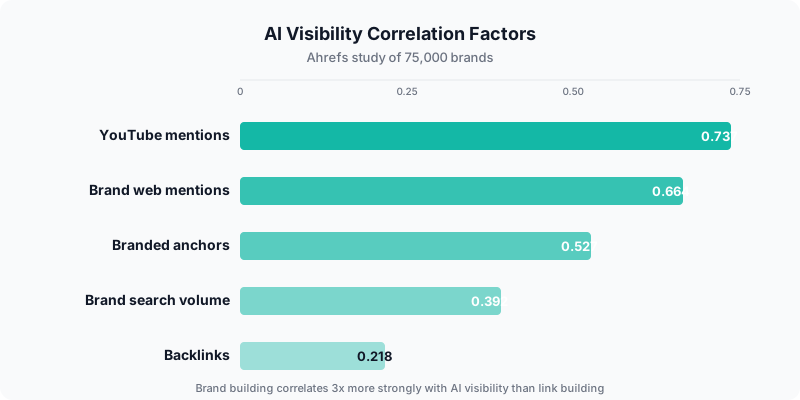
Brand mentions have the strongest correlation (0.664) with AI visibility. That is 3x stronger than backlinks (0.218). YouTube mentions rank highest of any single factor (0.737). Getting mentioned across independent sources builds the consensus signal AI platforms use to decide who to cite.
6. Freshness
76.4% of pages cited by ChatGPT were updated within 30 days. 40-60% of cited sources change each month. AI visibility is not set-and-forget. It needs regular content updates.
AI search optimisation for different business types
AI search optimisation is not one-size-fits-all. What matters depends on your business type and your customers. Ecommerce brands need product schema and review signals. B2B companies need thought leadership and entity authority. Local businesses need directory consistency and Google Business Profile. The table below shows where to focus.
| Business type | Primary AI platforms | What matters most | Quick wins |
|---|---|---|---|
| Ecommerce | ChatGPT (99.3% mention brands in product queries), AI Overviews, Gemini | Product schema, review signals, brand mentions, competitive pricing data | Add Product schema to all product pages. Get listed on comparison sites. Build review volume on Trustpilot. |
| B2B / SaaS | ChatGPT, Perplexity, Claude | Thought leadership content, case studies with data, entity authority, YouTube presence | Publish comparison content ("X vs Y"). Create YouTube explainers. Get mentioned on industry review platforms like G2 and Capterra. |
| Local business | AI Overviews, ChatGPT, Gemini | Google Business Profile, directory consistency, local schema, Bing Places, reviews | Claim Bing Places listing. Ensure identical NAP (name, address, phone) across 10+ directories. Add LocalBusiness schema. |
| Professional services | ChatGPT, AI Overviews, Perplexity | E-E-A-T signals, author profiles, credentials schema, answer-format content | Add author bios with credentials to all articles. Implement Person schema. Write FAQ content answering the exact questions clients ask. |
| Healthcare / legal | AI Overviews, ChatGPT | MedicalOrganisation or LegalService schema, compliance-reviewed content, authoritative citations | Add appropriate schema type. Cite authoritative sources (NHS, Law Society). Ensure all content is reviewed by a qualified professional. |
The common thread is entity clarity. AI engines must understand what your business is before they cite it. The differences are which platforms matter most and which signals carry the most weight for your category.
The Five Signal Model
Five core signal categories drive AI search visibility. These reflect how AI engines evaluate and cross-reference businesses before citing them. Weakness in one area can undermine strength in the others.
1. Identity clarity
AI engines must understand what your business is, what it does, and who it serves. This comes from consistent Organisation schema and matching descriptions across your website, LinkedIn, Google Business Profile, and directories. When five sources agree, AI confidence rises. When they disagree, the AI engine moves to a competitor with clearer signals.
2. Subject authority
AI engines check whether your business has genuine expertise. They measure content depth, author credentials, E-E-A-T signals, and authoritative brand mentions. A business with detailed, data-backed content and industry publication mentions carries more authority than one with thin pages.
3. Meaning architecture
This is how your content is structured for AI extraction. Answer capsules, tables, FAQ sections, clear heading hierarchies, and schema markup all play a role. AI engines do not read like humans. They parse structure. Pages with clear meaning architecture are easier to process and more likely to be cited.
4. Ecosystem validation
AI engines look for independent confirmation of your brand across the web. Brand mentions (0.664 correlation), YouTube presence (0.737), directory listings, review profiles, and social media all count. Think of it as the AI version of backlinks, but broader. Mentions without links still count. Presence on platforms with no direct links to your site still counts.
5. Signal consistency
All four previous signals must align. Your identity must match your authority claims. Your content must reflect your stated expertise. Your ecosystem presence must reinforce your website content, not contradict it. AI engines cross-reference everything. Inconsistencies reduce confidence and citations.
How to get started today
You do not need an agency or paid tools to start. Five free actions can improve your AI visibility within weeks. These are the foundations everything else builds on. Any business can do them today.
1. Fix your H1 heading
Your homepage H1 should state what your business does. Not a clever tagline or mission statement. Use a clear, factual statement that AI can extract. "Award-winning London law firm specialising in commercial property" beats "Unlocking your legal potential". AI engines use your H1 as a primary identity signal.
2. Add Organisation schema to your homepage
Organisation schema in JSON-LD tells AI engines your business name, description, address, contacts, social profiles, and logo. It takes 15 minutes to add. Free schema generators are available online, or you can write the JSON-LD yourself.
3. Allow AI crawlers in your robots.txt
Check yoursite.com/robots.txt. Make sure GPTBot, OAI-SearchBot, ClaudeBot, and PerplexityBot are not blocked. 23% of UK business websites block at least one AI crawler without knowing it. Remove any "Disallow" rules for these crawlers. This one change can open your site to AI platforms that could not see it before.
4. Submit your site to Bing Webmaster Tools
ChatGPT and Copilot index from Bing, not Google. If Bing cannot find your site, these platforms cannot cite you. Go to bing.com/webmasters, add your site, and submit your sitemap. Then set up IndexNow so updates reach Bing within minutes. This is free and takes about 20 minutes.
5. Align your descriptions across platforms
Check your description on your website, Google Business Profile, LinkedIn, and top 5 directory listings. Make them consistent. They do not need to match word-for-word. But they should describe the same business, services, and location without contradictions. Entity consistency is a free GEO signal.
Is AI search optimisation the same as SEO?
No. Traditional SEO ranks pages in Google using backlinks, keywords, and technical performance. AI search optimisation gets you cited in AI answers across multiple platforms. SEO helps you rank. AI search helps you get recommended. You need both. See our full GEO vs SEO comparison.
How much does it cost?
UK costs range from £1,500 to £25,000 per month. Small business: £1,500-£3,000/month. Mid-market: £3,000-£8,000/month. Enterprise: £8,000-£25,000+/month. Most agencies offer audits from £500-£2,000. See our full cost guide.
Where to start
If you're new to AI search optimisation:
- Get a free AI visibility audit to see where you currently stand across all platforms
- Read our agency comparison if you want professional help
- Browse our tool comparison if you want to do it yourself
- Not sure which? Read Agency vs Tool - we break down when each makes sense
- Comparing UK SEO agencies more broadly? See how to choose, compare, and rate UK SEO agencies in 2026 - answer capsules for the eight most-asked queries.
Frequently asked questions
Do I still need SEO if I do AI search optimisation?
Yes. 93.67% of AI Overview citations come from pages already in Google's top 10. AI search optimisation sits on top of SEO. It does not replace it. You still need strong traditional rankings. AI search ensures you also get cited when AI generates answers.
How long does AI search optimisation take to work?
Technical fixes (schema, robots.txt, content structure) can take effect within weeks. AI citation gains usually appear in 2-3 months. Major visibility improvements across multiple platforms take 3-6 months of steady work.
Can small businesses benefit from AI search optimisation?
Yes. Small businesses with clear descriptions, consistent directories, and basic schema often outperform larger competitors. Complex websites can confuse AI engines. The basics are free: clear identity, structured content, and AI crawler access.
Oliver Mackman
AI Search Analyst, SEOCompare
Oliver leads SEOCompare's editorial and comparison research. With over a decade in digital marketing, he oversees agency evaluation, tool testing, and AI search data analysis.
Last reviewed: 24 May 2026
Need help with AI search visibility?
Get a free AI visibility audit to see how your business appears across ChatGPT, Gemini, Perplexity, and AI Overviews.
Request your free audit