SEO Still Matters: How Rankings and AI Citations Overlap
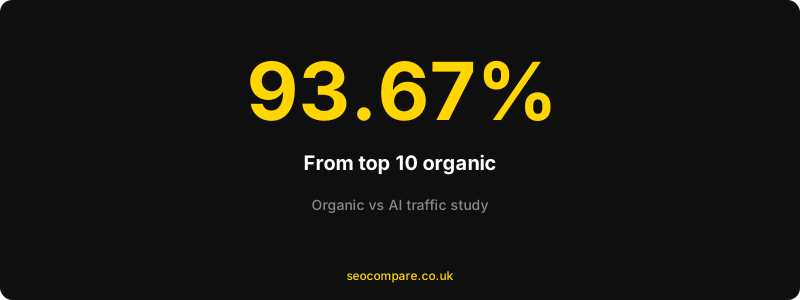
BrightEdge found the overlap between organic rankings and AI Overview citations grew to about 54.5% by late 2025, with roughly 17% from the top 10. SEO helps but is not sufficient.
SEO is not dead, but the link between rankings and AI citations is looser than many assume. BrightEdge found the overlap between AI Overview citations and organic rankings grew to roughly 54.5% by late 2025, while only around 17% of citations come from the organic top 10. So strong rankings clearly help, but a large share of AI citations come from pages ranking outside the top 10. Ranking is a strong signal, not a guarantee. Source: BrightEdge AI search insights.
What the overlap data means
The BrightEdge data tells us two things at once:
- SEO still matters - organic authority and AI citation correlate, and the overlap has grown over time, so ranking well improves your odds of being cited
- Ranking is not sufficient - most citations do not come from the top 10, and many top-10 pages are never cited, so other signals decide who gets picked
The question is not "SEO or AI search?" - it is "SEO plus what else?"
The SEO foundation
Every core SEO discipline still matters for AI search. Technical health, content quality, site architecture, page speed, mobile responsiveness, and authority signals all count. A site with SEO problems will not rank. A site that does not rank will not get cited in AI Overviews. The fundamentals have not changed. They have become the baseline rather than the goal.
What traditional SEO delivers for AI search:
| SEO discipline | AI search benefit |
|---|---|
| Technical SEO | Ensures AI crawlers can access and parse your content |
| Content quality | Higher quality content is more likely to be cited accurately |
| Site architecture | Clear structure helps AI understand topic relationships |
| Page speed | Faster pages are more efficiently crawled by AI bots |
| Authority signals | High-authority domains are cited more frequently |
| Metric | Value | Source |
|---|---|---|
| Overlap between AI Overview citations and organic rankings (late 2025) | ~54.5% | BrightEdge |
| Share of AI Overview citations coming from the organic top 10 | ~17% | BrightEdge |
Source: BrightEdge AI search insights
View as plain-text Markdown
### Rankings vs AI Overview citations: the overlap figures

| Metric | Value | Source |
| --- | --- | --- |
| Overlap between AI Overview citations and organic rankings (late 2025) | ~54.5% | BrightEdge |
| Share of AI Overview citations coming from the organic top 10 | ~17% | BrightEdge |

Source: BrightEdge AI search insights
“Overlap statistics blend two effects: pages cited because they rank, and pages that both rank and get cited because they are genuinely good. BrightEdge's overlap figure has also grown over time, so the relationship is moving. Keep doing SEO, but treat ranking as an entry ticket to the citation pool, not a claim on it.”
The additional layer
Ranking in the top 10 gets you into the pool of potential citations. The following signals determine whether you are actually cited from that pool:
- Structured data - Organisation, Article with Author, and similar schema that make your entity and content machine-readable
- Answer-first content format - paragraphs that lead with a clear, extractable answer rather than building up to one
- Entity clarity - clear H1, consistent descriptions, Organisation schema with sameAs
- Brand mentions - branded mentions correlate about 3x more strongly than backlinks with AI visibility (Ahrefs)
- Bing indexing - for ChatGPT and Copilot visibility (separate from Google rankings)
The "SEO is dead" myth
Every time new technology emerges, commentary declares SEO dead. Social media was supposed to kill SEO. Mobile was supposed to kill SEO. Voice search was supposed to kill SEO. None of them did.
AI search will not kill SEO either. The BrightEdge overlap data shows organic authority remains a major input to AI visibility in Google's ecosystem. What AI search changes is the definition of success. Ranking on page one is no longer the finish line. It is one strong signal among several.
The GEO layer
Generative Engine Optimisation (GEO) is the discipline of optimising content for AI citation beyond traditional ranking. It sits on top of SEO, not instead of it. The practical difference:
| SEO goal | GEO addition |
|---|---|
| Rank on page one | Get cited in the AI answer above page one |
| Optimise for keywords | Optimise for entities and brand recognition |
| Build backlinks | Build brand mentions across platforms |
| Write for Google's algorithm | Write for AI extraction (answer-first format) |
| Track rankings | Track citations across ChatGPT, Gemini, Perplexity |
Read our full GEO vs SEO comparison · See all AI search statistics
Oliver Mackman
AI Search Analyst, SEOCompare
Oliver leads SEOCompare's editorial and comparison research. With over a decade in digital marketing, he oversees agency evaluation, tool testing, and AI search data analysis.
Last reviewed: 11 June 2026
Need help with AI search visibility?
Get a free AI visibility audit to see how your business appears across ChatGPT, Gemini, Perplexity, and AI Overviews.
Request your free audit